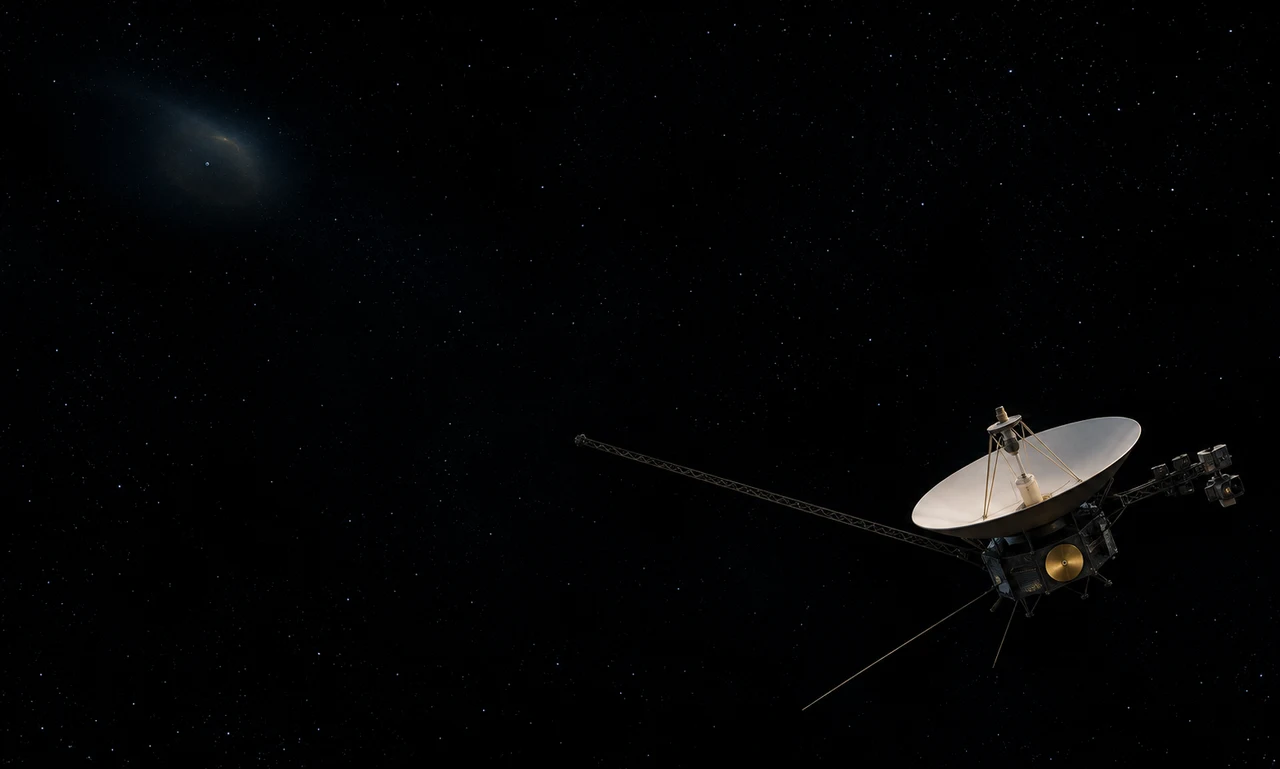
Voyager 1 has crossed a distance no other human-made object has reached: one light-day from Earth. The milestone means that light, or a radio signal travelling at the same speed, takes 24 hours to cross the distance in one direction.
NASA places the distance at about 16.09 billion miles, or 25.89 billion kilometres. Voyager 1 is travelling at roughly 38,000 miles per hour, yet it took nearly 50 years to reach a distance that light covers in a single day.
A measure of distance, not duration
The phrase “light-day” can sound like a unit of time, but it describes how far light travels in 24 hours. Light moves at about 299,000 kilometres per second. Multiplying that speed across a day produces a scale that is difficult to picture — and gives a simple way to understand the growing communication gap.
Commands sent from Earth now require a day to arrive. A response needs another day to return, so even under ideal conditions a round-trip exchange spans about 48 hours. That delay changes how engineers plan, diagnose problems and operate an aging spacecraft with limited power.
A mission that outlived its original map
Voyager 1 launched in 1977. Along with Voyager 2, it transformed knowledge of Jupiter and Saturn. Voyager 2 continued to Uranus and Neptune, becoming the only spacecraft to visit both planets.
Both probes later entered interstellar space, beyond the main bubble of particles and magnetic influence created by the Sun. They continue to return measurements from a region no other active spacecraft has sampled directly.
Each Voyager also carries a golden record with sounds and images intended to represent Earth. The records were conceived as messages for an unknown future, but their immediate meaning may be closer to home: they reflect the care with which people chose to introduce their planet beyond the solar neighbourhood.
The one-light-day milestone is therefore both technical and human. It measures the extraordinary patience required to keep a machine operating across generations, and it turns an abstract cosmic distance into a familiar unit — one day of light, reached through half a century of travel.