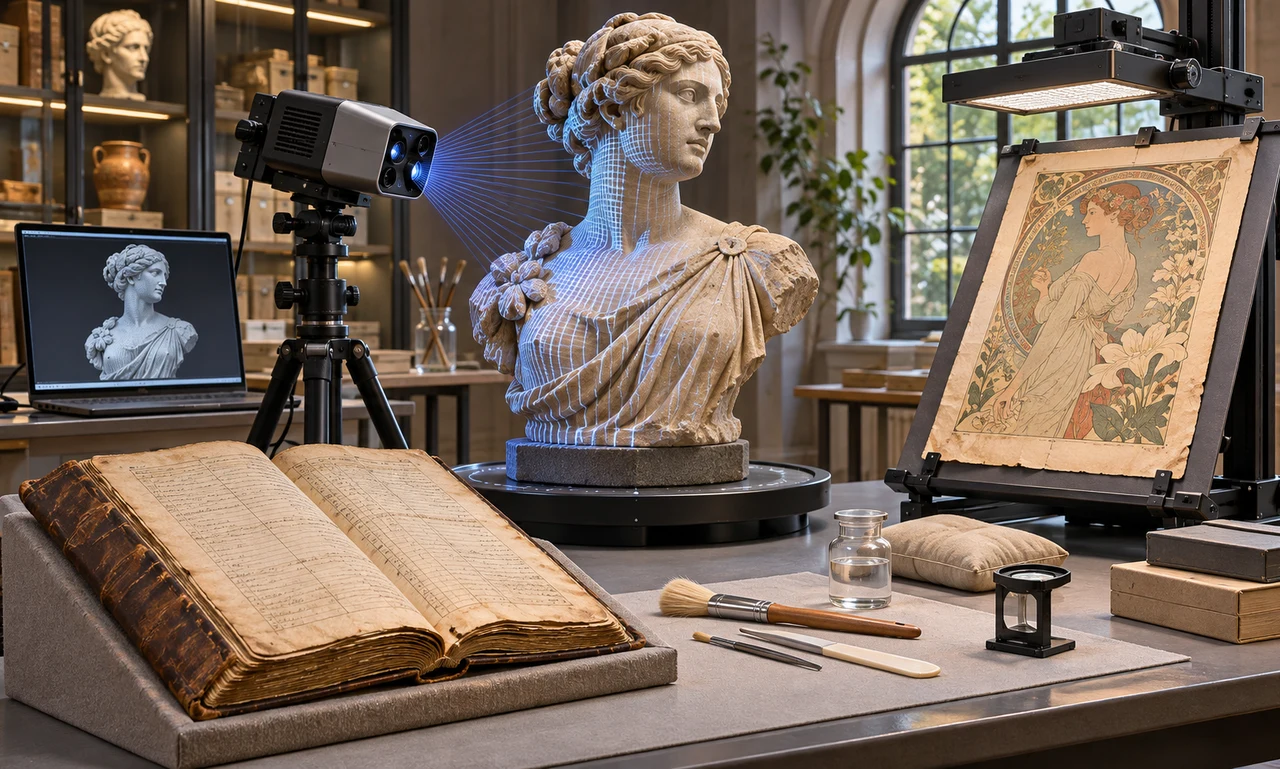
UNESCO and Arius Technology have begun a partnership to create high-resolution digital records of artworks, archives and historic spaces. The project is designed to preserve fine physical details while making parts of UNESCO’s heritage more accessible beyond its Paris headquarters.
The initial phase began in October. It includes selected works from UNESCO’s art collection, emblematic spaces in the headquarters building and documentary materials that are fragile, unusually large or difficult to capture with ordinary photography.
Recording more than an image
Specialized two- and three-dimensional systems can measure micro-relief, surface texture and structural detail. Those records can support conservation by providing a precise baseline. If an object changes through age, handling or environmental conditions, specialists can compare its later state with an earlier measurement.
Planned subjects include the guest books of UNESCO and its predecessor, the original register of the 1954 Hague Convention on protecting cultural property during armed conflict, early issues of the UNESCO Courier, historic posters and the organization’s Human Rights exhibition kit.
Robotic automation, precision capture and secure long-term storage will be supported by several technology partners. Crucially, the final files are to be transferred to UNESCO in open, independent formats, including the Stanford Polygon format. That reduces dependence on a single vendor’s software and improves the chance that the records will remain usable as systems change.
Access and preservation can reinforce each other
A detailed digital counterpart is not the same as an original object. It cannot reproduce material history, scale or the experience of standing before a work. It can, however, allow researchers to study details remotely, help educators bring collections into classrooms and give conservators a tool for monitoring condition.
The partnership treats digitization as stewardship rather than replacement. Its strongest promise lies in connecting two responsibilities that are sometimes discussed separately: protecting vulnerable originals and opening cultural memory to a wider public. When the data remains well documented, securely stored and openly readable, a scan becomes more than a picture — it becomes part of the object’s continuing history.