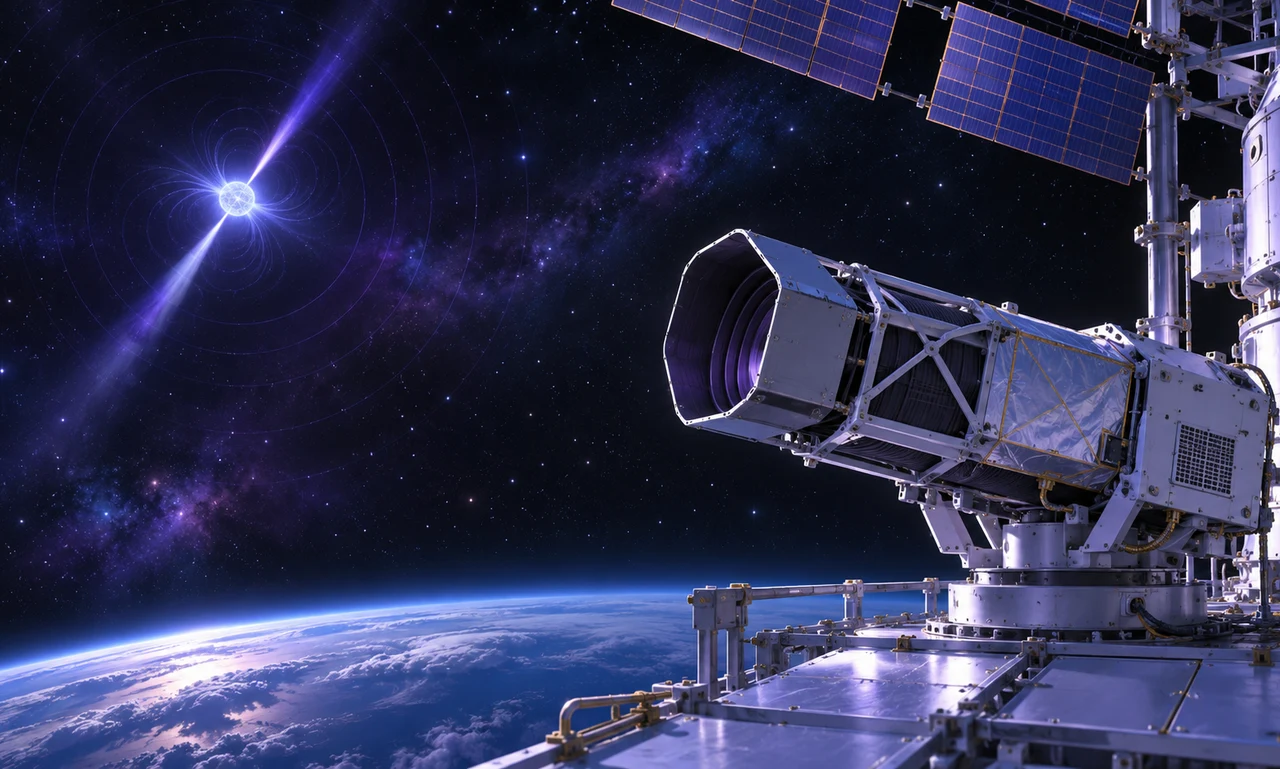
NASA’s Neutron star Interior Composition Explorer, better known as NICER, has ended science operations on the International Space Station. The telescope spent more than six years beyond its initial mission studying some of the densest objects in the universe.
Neutron stars are the compact remains of massive stars that exploded. They can contain more mass than the Sun inside a sphere roughly the size of a city. NICER examined their X-ray emissions with precise timing measurements, giving researchers a way to investigate matter under pressures that cannot be reproduced in laboratories on Earth.
Timing pulses from dense stellar remnants
Many neutron stars spin rapidly and send beams of radiation across space. When those beams sweep past Earth, astronomers detect regular pulses. NICER’s measurements helped researchers estimate the size and mass of selected neutron stars, information that can narrow the range of possible theories about their interiors.
The mission also demonstrated a navigation concept known as SEXTANT. By using pulsars as natural beacons, the experiment showed how a spacecraft could calculate its position independently in deep space. The idea is sometimes compared with satellite navigation on Earth, although the signals and operating environment are very different.
A mission attached to a working laboratory
Operating from the space station gave NICER access to the sky while placing it on a busy human outpost. Its observing schedule had to fit the station’s orbit, structure and other activities. That setting made the instrument both a research observatory and an example of how science hardware can share an existing platform.
The end of data collection closes the operational chapter, but analysis will continue. Like many astronomy missions, NICER leaves an archive that researchers can revisit with new questions, improved models and observations from other telescopes.