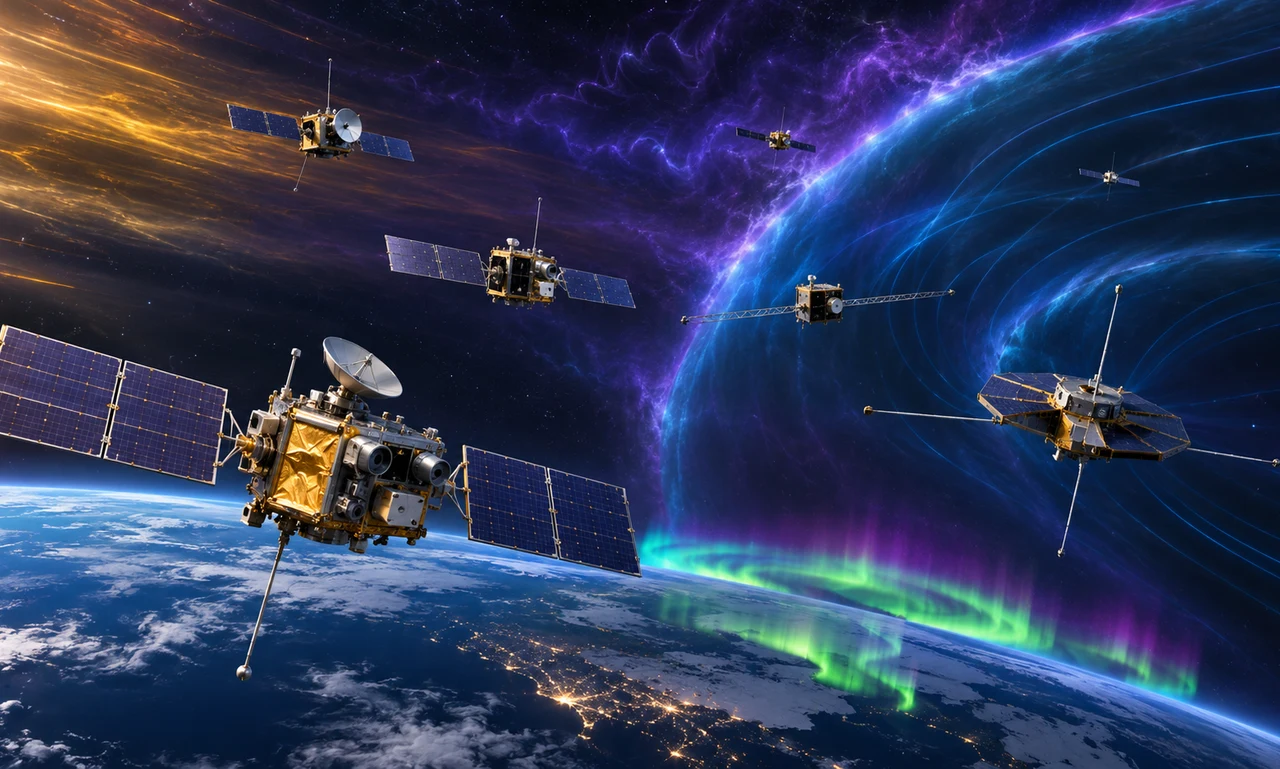
Space around Earth is not empty. It is filled with plasma, a gas of charged particles carried outward by the solar wind. Where that flow meets the planet’s magnetic field, energy moves through a turbulent boundary that can produce auroras, disturb satellites and contribute to problems in power infrastructure.
The European Space Agency has selected Plasma Observatory as its next medium-class science mission. Seven coordinated spacecraft will measure particles and electric and magnetic fields at the same time from different points in Earth’s magnetic environment.
One scale cannot explain the whole event
Plasma processes unfold across distances ranging from a few kilometres to tens of thousands of kilometres, and across times from milliseconds to minutes. Earlier missions such as ESA’s four-spacecraft Cluster mission produced major discoveries, but could examine only one scale at a time.
Plasma Observatory is designed to see fine detail and the wider system together. Its formation will let researchers follow how a small, fast interaction connects with a larger change in the magnetosphere.
Earth provides a nearby laboratory for physics that operates throughout the cosmos. Plasma makes up more than 99% of visible matter in the universe, including stars and the material between planets. Understanding its behaviour near Earth can therefore improve interpretations of distant places that spacecraft cannot visit directly.
The mission enters a long development path
The selection fills ESA’s M7 mission slot and follows a process that began with an open call in 2021. Concepts were reviewed for scientific value, technical feasibility and how well they complemented other missions.
Formal adoption, construction and testing still lie ahead, with launch provisionally planned for the late 2030s. ESA also advanced four concepts for a later medium-class mission and three candidates for a fast-class mission into further study during 2027.
The seven-spacecraft design reflects the central scientific challenge: a plasma environment cannot be understood from a single point. By watching several distances and times at once, the mission aims to show how local turbulence becomes a system-wide event.