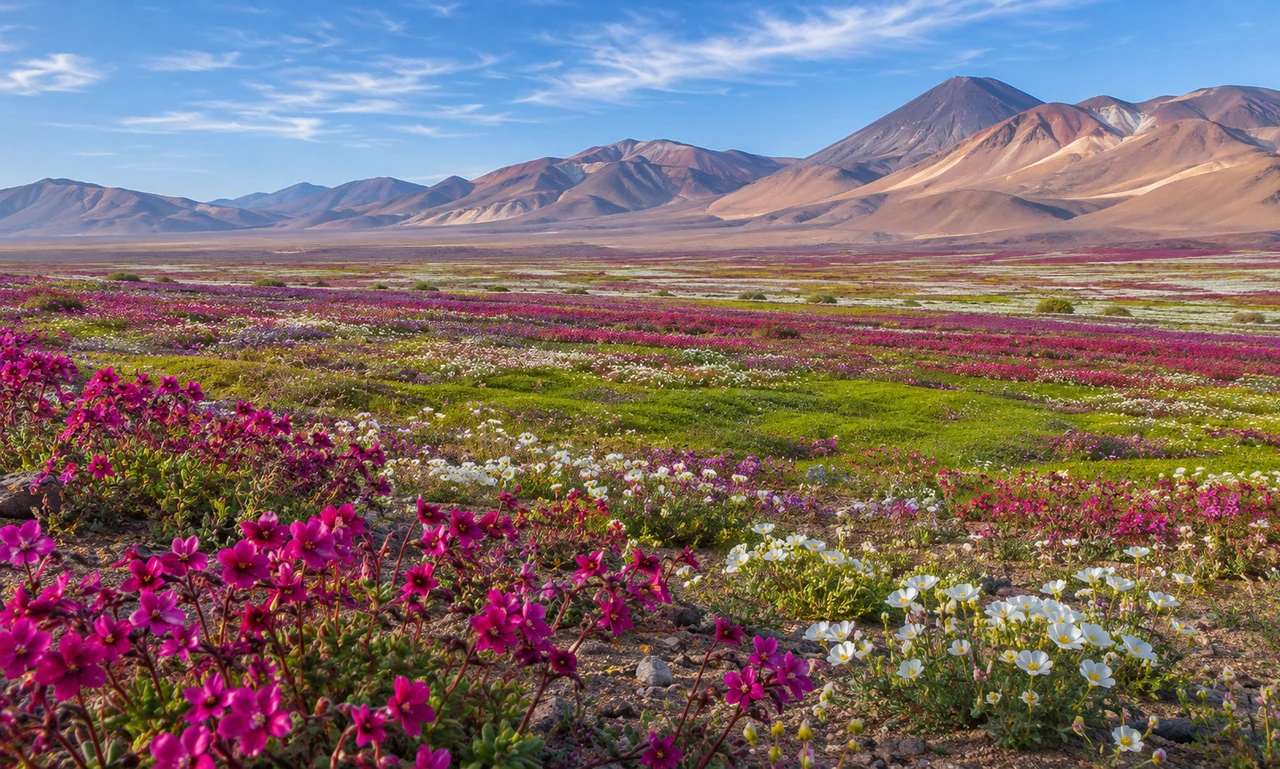
One of Earth’s driest landscapes has erupted in colour after an unusually wet winter. Broad areas of Chile’s Atacama Desert are showing red-purple, green and white vegetation in what may be the most extensive flowering event observed there during the satellite era.
Landsat 8 and Landsat 9 recorded the transformation from orbit. The images reveal how a place known for extreme aridity can shift rapidly when moisture arrives at the right time and dormant seeds respond.
Rain reached the desert from an unusual route
Storms in mid-July brought substantial precipitation to northern Chile. An atmospheric river — a long corridor of concentrated water vapour — helped feed the event. El Niño conditions also altered the Pacific storm track, making winter rain more likely in a region where years may pass with very little.
The desert’s flowering is not a single blanket of one species. Different colours and textures mark a mosaic of plants responding to local soil, elevation and moisture. Seeds and underground structures can remain inactive through long dry periods, then germinate when temperature and rainfall align.
A rare event with a longer history
Researchers identified 13 flowering episodes in the Atacama between 1981 and 2015. That record shows the phenomenon is recurring, but not regular. Each event differs in reach, duration and ecological effect, and satellite coverage allows scientists to compare changes across an enormous area that would be difficult to survey entirely from the ground.
The bloom may support insects, birds and other animals by briefly expanding food and habitat. It also attracts visitors, creating a need to protect fragile plants and soils from vehicles and heavy foot traffic. A spectacular display can be damaged long before the next rain gives it a chance to return.
Scientists will continue tracking how long the 2026 vegetation persists and how it relates to rainfall patterns. The broader lesson is visible from orbit: deserts are not empty or lifeless. Their biological rhythms may be paused rather than absent, waiting for a short-lived weather pattern to reveal an ecosystem built around patience.