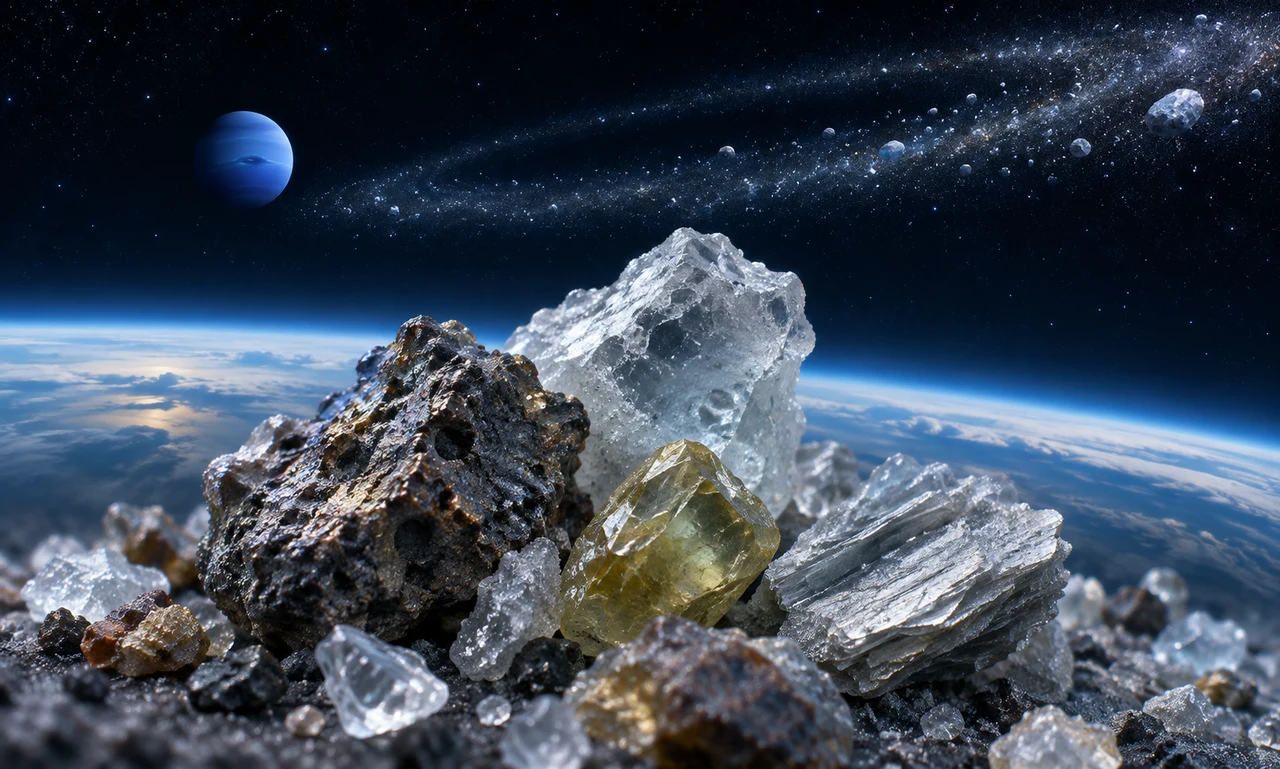
Twelve grains of dust collected high above Earth have given scientists a rare physical sample of the distant solar system. The particles appear to have travelled from the Kuiper Belt, the cold region beyond Neptune that holds icy remnants from the planets’ formation.
NASA researchers gathered the grains in Earth’s stratosphere using an ER-2 aircraft. That altitude reduces contamination from ordinary ground material, but identifying a particle’s birthplace still requires evidence written at scales far smaller than a grain of sand.
Following tracks left by solar particles
The team examined trails made when energetic particles from the Sun struck the dust in space. Those tracks helped distinguish extraterrestrial grains from material that had spent its history on Earth. Electron microscopes and an ion microprobe then revealed the particles’ minerals and isotopic composition.
Several grains contained minerals that form when water reacts with dust. Their oxygen also carried an unusually heavy isotopic signature. Together, those clues point to ancient ice in the outer solar system rather than the warmer, more thoroughly mixed material found closer to the Sun.
A record from a less-mixed neighbourhood
The finding supports a picture in which the young giant planets limited the exchange of material between the inner and outer solar system. If the regions remained partly separated, dust beyond Neptune could retain a distinctive chemical history for billions of years.
That matters because most direct samples available to laboratories come from the Moon, asteroids or comets that have travelled inward. Kuiper Belt objects are immensely distant, and spacecraft encounters provide only brief remote measurements. A microscopic visitor reaching Earth therefore offers a different kind of access: material that can be cut, imaged and measured atom by atom.
Twelve particles cannot describe the entire Kuiper Belt, and the route each one took remains complex. Their value lies in proving that stratospheric collections can preserve a detectable signal from this remote reservoir. The atmosphere above us is not only a boundary; occasionally, it is a sample tray for the farthest reaches of our planetary neighbourhood.